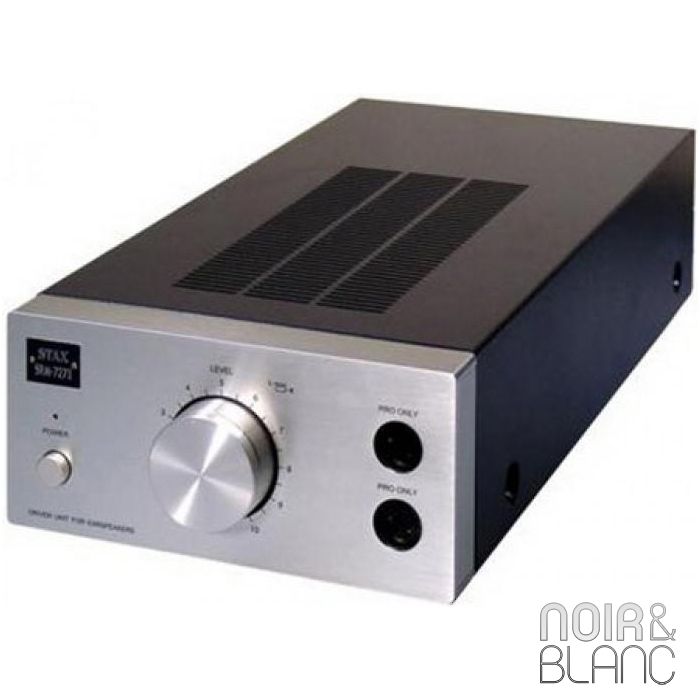
NEW VISTAS FOR THE NON-FEEDBACK OUTPUT STAGE
The first performance feature required of audio equipment is the capacity to convert air vibrations into sound waves so that the slightest signal can be appropriately heard by the ear. This means that an essential condition of the vibrating medium,... Lire la suite
Ce produit n'est plus disponible
Livraison gratuiteou retrait en magasin
Paiement en ligne 100% sécurisé
Garantie 2 ans
Une question avant de finaliser votre commande ?
Notre équipe d'experts vous réponds par email ou au +32 538 44 51(mar-sam, 10h-12h30 et 14h-18h30)
Fiche technique
Informations techniques complémentaires
Type
:All-stage semiconductors Low noise dual FET input NON-NFB Class A operation, Pure balance DC amplifier configuration Earspeaker driver unit
Frequency Response :DC to 115,000Hz w/ SR-007 or SR-404
High Harmonic Distortion :Max. 0.01% (with 100 to 10kHz, 100V r.m.s. )
Gain :54dB (x500)
Input Terminal
:RCA OR XLR with 1 RCA parallel out
Rated Input Level :200mV / 100V Outputs
Max. Input Level :
Input Impedance :50Kohm(RCA), 50kohm x2 (XLR)
Max. Output Voltage :450V r.m.s. (1kHz)
Standard Bias Voltage :PRO 580V x 2
Power Voltage Frequency :117V (50Hz / 60Hz)
Power Consumption :46W
Temperature & Humidity :0 to 35ºC / 90% max. without condensation
Dimensions :7.7 (W) x 4.1 (H) x 16.5 (D) in
Weight :11.5lbs
Color :Silver or Black
L'avis de Noir & Blanc
NEW VISTAS FOR THE NON-FEEDBACK OUTPUT STAGE
The first performance feature required of audio equipment is the capacity to convert air vibrations into sound waves so that the slightest signal can be appropriately heard by the ear. This means that an essential condition of the vibrating medium, i.e. the diaphragm, in the speaker which constitutes the system of conversion from electrical signal to air vibration is that it needs to be as light as possible. Divided vibration, which is unavoidable in the case of point drive, is possible, as is also ultra-miniaturization if total drive is possible. Moreover, if headphones are used, there will be reduction in the mass of air that needs to be driven, creating a more ideal situation. The electrostatic (condenser) type is the system that comes closest to this ideal. STAX refers to speakers of this type as “earspeakers” and has continuously sought for the ideal form. Since a dedicated unit is needed for drive purposes, the development of such units is equivalent to the pursuit of high sound quality in the electrical signal system. The matching drive system and the amplifier system are used for driving electrostatic speakers, and in the case of amplifiers it is possible to build circuits by means of vacuum tubes. In the case of electrical signal systems too, it is generally known that sound quality varies extensively depending on the circuit configuration, parts, etc. Which should be selected? There is also the element of musicality that needs to be taken into consideration when determining the sound that is the be-all and end-all of audio. The new SRM-727II employs semiconductor output drive stage and non-feedback (NON-NFB) output stage for the first time ever in a STAX driver unit. A pure balance DC amplifier configuration is used for the large current emitter follower Class A output stage. A significant increase in dynamic range especially in the upper frequency has been achieved. A high level of sound purity is achieved through the simple two-stage amplification circuit with low-noise FET input stage. This is a brand new driver unit that opens up new vistas for the sense of mass and textural expression supported by a virtually unparalleled degree of resolution, a natural sense of openness, and a powerful power section.
CLASS A, NON-FEEDBACK (NON-NFB)
The SRM-727II features non-feedback (NON-NFB) output stage for the first time ever in STAX drivers. Large current emitter follower Class A amplification circuit. This makes it possible to achieve a much more vivid and dynamic sound quality with frequency response raised to 115kHz. (from 100kHz)
NEW DESIGN
A newly designed front panel with rounded corners in brushed finish. Available in Silver or Black
PURE BALANCED SYSTEM
The electrostatic method is a playback method which involves the installation of drive electrodes on either side of a high-polymer film diaphragm with a thickness of only a few microns into each of which a plus signal and a minus signal are fed. This means that XLR connection with a pure balance output CD player makes it possible to listen to the original sound permitted by the balance system without a conversion circuit.
HIGH QUALITY PARTS, HIGH QUALITY SOUND
Careful selection of parts with high consideration on sound quality, performance, and the environment. Low noise FET is used at the input stage with a simple two-stage amplifying circuit. A natural and pure sound quality with high information quantity.
BYPASS CONNECTION
SRM-727II provides a bypass mode that enables "direct" connection to preamplifiers, passive volume controls or integrated amplifiers and receivers with Pre-out. A direct switch that avoids duplication of volume control.
FiiO produit aujourd'hui plus de deux cents références, et leurs noms ressemblent à des immatriculations : KA17, BTR13, FH11, FT1 Pro, M23, K13 R2R. On comprend que ça décourage. La bonne nouvelle, c'est que cette nomenclature n'est pas arbitraire. Chaque...
Arcam fait partie de ces marques dont la gamme décourage au premier regard. Entre un A15+ et un A25+, un SA30 et un SA45, un AVR11 et un AVR21, les écarts ne sautent pas aux yeux et les noms n'aident...
Pourquoi s'encombrer d'un appareil supplémentaire quand on a déjà un smartphone dans la poche ? La question est légitime, et nous ne prétendons pas qu'un baladeur audiophile est indispensable. Mais il répond à quelque chose que le téléphone ne sait...